

A survey of 164 people managing GI conditions shows why tracking alone falls short – and why tracking-but-unsatisfied users are ready for more.
Introduction
If you live with a gastrointestinal (GI) condition, chances are you’re already doing something about it.
You’re tracking meals. Logging symptoms. Using a food diary, fitness app, or health tracker to try to make sense of what’s happening in your body.
And yet, for many people, the results still feel disappointing.
To understand why, we surveyed 164 people who were already managing at least one GI condition. What we found wasn’t a lack of effort or engagement – it was something more revealing: The people doing the most tracking are often the least satisfied with the tools they’re using.
Who we surveyed
Survey respondents were screened to include only individuals actively managing at least one GI condition (N = 164), 52% male and 48% female, ages 18 to 65+.
This survey was intentionally limited to people already managing GI conditions. The results describe behaviors and attitudes within a GI-managed population by design. Note from Fig. 1 that while Irritable Bowel Syndrome (IBS), Gastroesophageal Reflux Disease (GERD), and food intolerance top the list of diagnoses, Inflammatory Bowel Disease (IBD) and other GI conditions were well-represented.

[N = 164 people who are managing at least one GI condition.]
Self-tracking is already the norm
Many people managing GI conditions already use food diaries, symptom trackers, and general health or fitness apps (Fig. 2). Thirty-one percent of respondents (51 of 164) reported using digital tools such as food diaries, symptom trackers, or health and fitness apps to help manage GI symptoms.
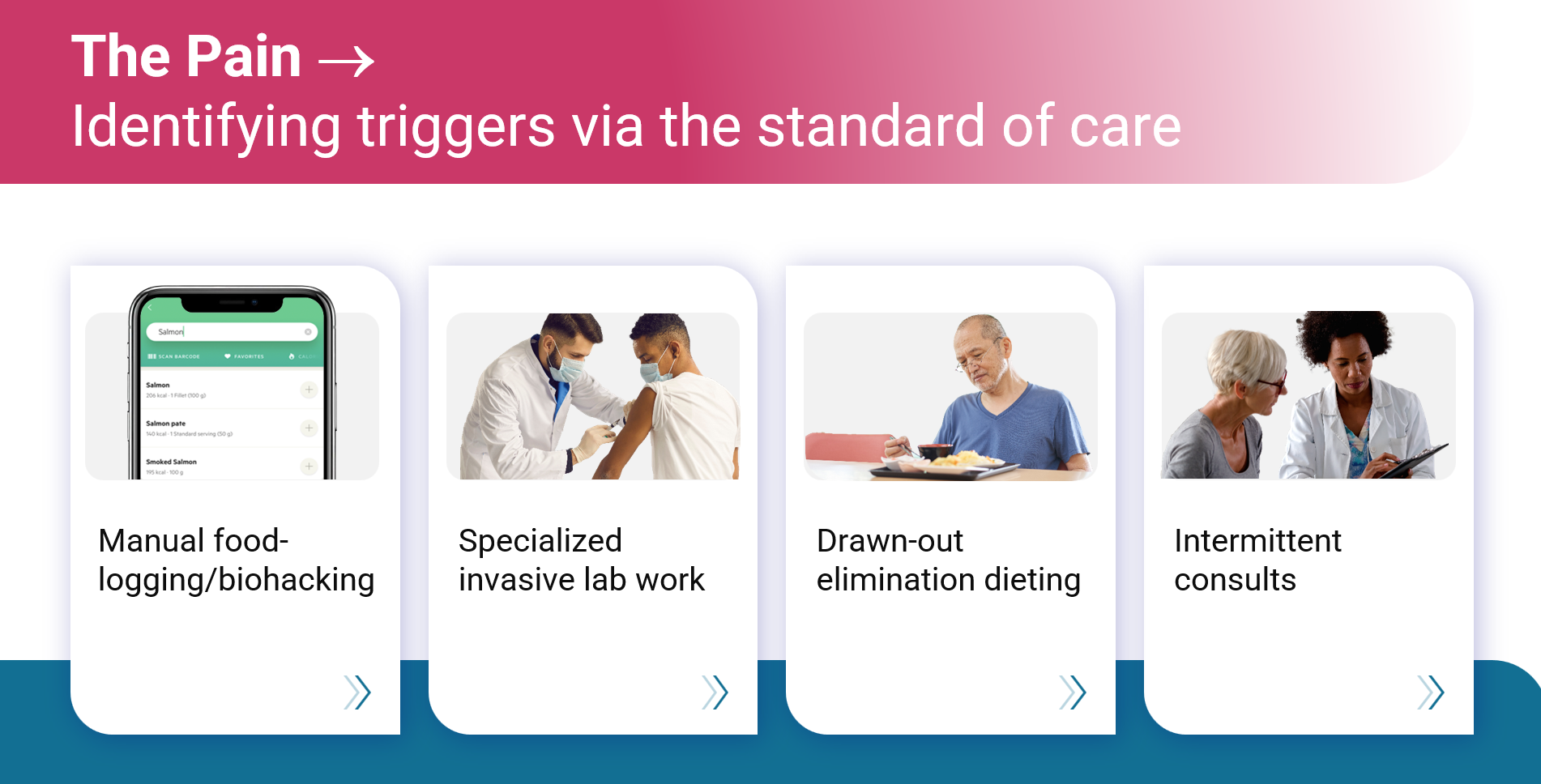
It’s also worth noting that elimination dieting, taking supplements, and taking over-the-counter medications are the most common ways people are managing their GI conditions. Taken together, these responses show that much of GI management happens at home, outside the clinic. Between appointments, people are tracking meals and symptoms, adjusting diets, and relying on over-the-counter strategies to manage how they feel day to day.

High effort, low satisfaction
Despite widespread use of tracking tools, far fewer respondents feel confident or satisfied with how their GI condition is managed. People are investing time and effort into managing their symptoms, yet many still do not feel good about the results (Fig. 3). This frustration is especially pronounced among those doing the most tracking. Among the 51 respondents who actively track food and symptoms, ~80% agreed with the statement: “I would prefer virtually any new method of managing my GI condition(s) over what I’m doing now.” The limitation is not effort, but rather the lack of timely, individualized feedback.

People want clear, personalized links between food and symptoms
As shown above, people who actively track food and symptoms consistently express frustration with not knowing which foods or meals are driving their GI symptoms. The strongest agreement centers on statements such as “I wish I knew which foods or meals were causing my GI symptoms” and “I wish I had a more personalized plan for managing my GI condition(s).” Importantly, this pattern is not limited to active trackers. Across the full study population of 164 respondents – most of whom are not currently using food-tracking apps – nearly 73% agreed with the former statement and 59% agreed with the latter.
This desire for clarity and personalization goes beyond understanding alone. Among respondents who actively track food and symptoms, more than 70% indicated a preference for a personalized, diet-based approach over medication when managing their GI symptoms. Taken together, these findings suggest that individualized food-related insight is widely viewed as a critical missing piece in how GI conditions are managed today.
GI symptoms go beyond diet alone
As shown in Figure 4, people who actively track food and symptoms overwhelmingly point to diet as a key driver of GI symptoms – but they do not see diet in isolation. While diet is the most frequently cited factor (≈80%), stress, medications, and activity level are each reported by more than half of respondents, with sleep and environmental factors also playing meaningful roles.
Taken together, these responses highlight that GI symptoms are shaped by a combination of influences that vary from person to person. Approaches that focus narrowly on food alone risk missing a large part of the picture, whereas systems that account for multiple, individualized factors are better aligned with how people actually experience and manage their symptoms.

A more personalized, adaptive approach to GI management
Taken together, the findings in this survey point to a clear gap in how GI conditions are currently managed day to day. People are already doing the work – tracking meals, monitoring symptoms, experimenting with diet, and adjusting behavior between clinical visits – yet many still feel uncertain about what is helping, what is hurting, and what to do next. The limitation is not effort, but actionable, personalized feedback.
What’s missing is a way to translate everyday actions into clear, individualized guidance. Actively managing a GI condition requires more than static rules or generic food lists; it requires insight that adapts to the individual, reflects multiple contributing factors, and evolves as the body changes over time. Without that, management remains reactive, relying on trial and error rather than informed decision-making.
For those living with GI conditions, the path forward is not more logging for its own sake, nor stricter adherence to one-size-fits-all plans. It is a system that helps people make sense of their own data, connects actions to outcomes, and supports earlier, more confident choices in daily life. The survey makes clear that people are ready for this shift – and that it represents a meaningful opportunity to improve how GI health is managed outside the clinic.

Leave a Reply